Bisection Method
Goals
Understand the principle of the bisection method (Intermediate Value Theorem), its algorithm, linear convergence, stopping criteria, and comparison with Newton's and secant methods.
Prerequisites
- Chapter 6: Absolute Error / Chapter 7: Relative Error
- Chapter 9: Truncation Error
- Continuous functions and the Intermediate Value Theorem
Contents
1. Principle
The bisection method is a root-finding algorithm based on the Intermediate Value Theorem.
Intermediate Value Theorem
If $f$ is continuous on $[a,b]$ and $f(a)\cdot f(b) < 0$, then there exists at least one $c \in (a,b)$ such that $f(c) = 0$.
By applying this theorem iteratively, the interval is halved at each step, bracketing the root ever more tightly.
2. Algorithm
Bisection Method
- Choose an initial interval $[a,b]$ such that $f$ is continuous and $f(a)\cdot f(b) < 0$.
- Compute the midpoint $c = (a+b)/2$.
- If $f(c) = 0$, then $c$ is a root; terminate.
- If $f(a)\cdot f(c) < 0$, set $b \leftarrow c$; otherwise set $a \leftarrow c$.
- Repeat steps 2--4 until a stopping criterion is satisfied.
3. Convergence
After $n$ iterations, the width of the interval containing the root is
$$|b_n - a_n| = \dfrac{b_0 - a_0}{2^n}$$and the error of the midpoint $c_n$ satisfies
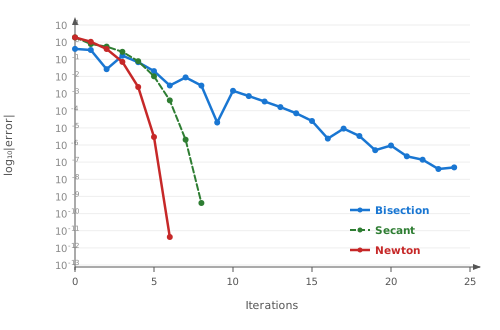
This is linear convergence: each iteration yields approximately one additional bit of accuracy. When the initial interval has unit width, obtaining $k$ decimal digits of precision requires approximately $k \times \log_2 10 \approx 3.32k$ iterations.
4. Stopping Criteria
Iteration is terminated when any of the following conditions is satisfied. Here $\varepsilon$ and $\delta$ are user-specified tolerances (e.g., $10^{-8}$), and $N_{\max}$ is the maximum number of iterations (to prevent infinite loops).
- Interval width: $|b_n - a_n| < \varepsilon$ (the root is located within precision $\varepsilon$)
- Function value: $|f(c_n)| < \delta$ ($c_n$ is sufficiently close to a root)
- Iteration count: $n \geq N_{\max}$ (computation time limit)
The interval width criterion is the most reliable. The required number of iterations follows from $|b_n - a_n| = (b_0-a_0)/2^n < \varepsilon$ as $n = \lfloor\log_2((b_0-a_0)/\varepsilon)\rfloor + 1$ (one iteration fewer suffices if only the midpoint $c_n$ must be within $\varepsilon$).
4.1 Practical guidelines for the stopping criterion
- Interval-width tolerance $\varepsilon$: a safe choice is roughly twice the required absolute accuracy (e.g. for $10^{-8}$ accuracy, set $\varepsilon = 2 \times 10^{-8}$). The error of the returned midpoint $c_n$ is at most $\varepsilon/2$.
- Combine with the function-value test: relying on $|f(c_n)| < \delta$ alone risks early termination in regions where $f$ is nearly flat, i.e. where $|f'|$ is small (since $|f(c)| \approx |f'(x^*)| \, |c - x^*|$, a tiny $|f|$ does not necessarily imply a small error in $x$). Combine it with the interval-width test using a logical AND.
- Maximum iteration count $N_{\max}$: set roughly twice the theoretical requirement $n$ above as a safety margin to absorb floating-point round-off that may force extra iterations.
5. Advantages and Disadvantages
| Advantages | Disadvantages |
|---|---|
| Convergence is guaranteed for continuous functions | Slow convergence (linear) |
| No derivative $f'(x)$ required | Requires opposite signs at endpoints of initial interval |
| Extremely simple to implement | Cannot find repeated roots of even multiplicity (no sign change) |
| Number of iterations is predictable in advance | Difficult to extend to multiple dimensions |
The fact that no derivative is required is a significant practical advantage. Newton's method converges quadratically but requires the computation of $f'(x)$ at each iteration. When an analytical expression for $f'(x)$ is unavailable, or when $f$ itself is the output of a numerical simulation, Newton's method becomes impractical. The secant method does not require derivatives either, but may diverge depending on the choice of initial values. The bisection method is "slow but reliable" and is also useful as a preprocessing step to provide initial values for other methods.
The reason that extension to multiple dimensions is difficult lies in the essence of the bisection method: bracketing the root between two points with opposite signs. Whether the bisection method is applicable depends not on the dimension of the domain but on the dimension of the codomain.
- Scalar codomain ($f: \mathbb{R}^n \to \mathbb{R}$) -- The bisection method is applicable. By parameterizing the line segment between two points $\mathbf{a}$ and $\mathbf{b}$ in $n$-dimensional space as $g(t) = f(\mathbf{a} + t(\mathbf{b} - \mathbf{a}))$, the standard one-dimensional bisection method can be applied to $g: [0,1] \to \mathbb{R}$.
- Vector codomain ($\mathbf{f}: \mathbb{R}^n \to \mathbb{R}^n$) -- The bisection method does not apply as is. Since the output is a vector, a single sign cannot tell which side contains the root (generalizations based on the combination of componentwise signs or on the topological degree exist, but they are beyond the scope of this article).
Repeated roots
The bisection method assumes $f(a) \cdot f(b) < 0$, but at a repeated root of even multiplicity (e.g. $f(x) = (x-1)^2$) the function does not change sign in a neighborhood of the root, so the method cannot be applied directly. At a repeated root of odd multiplicity (e.g. $(x-1)^3$) the sign does change, so bisection still works as is (at the same rate as for a simple root: one bit per iteration).
Example: $f(x) = (x-1)^2$ has a repeated root at $x=1$, but $f(x) \ge 0$ for both $x < 1$ and $x > 1$. Regardless of how the initial interval $[a, b]$ is chosen, $f(a) f(b) \ge 0$, so the bisection precondition fails.
Workarounds:
- Apply the bisection method to $f'(x)$ instead (a repeated root of $f$ is often a simple root of $f'$). A root of $f'$ is also a stationary point, so always verify that $f = 0$ at the point found.
- Switch to Newton's method. Newton does not require a sign change, so it can be used even at repeated roots where bisection cannot start. However, it loses its quadratic convergence; at a root of multiplicity $m$ it becomes linear with rate $1 - 1/m$. For a double root ($m=2$) the rate is $1/2$, the same as bisection; for $m \ge 3$ Newton is actually slower than bisection (whose rate stays at $1/2$).
- Use modified Newton $x_{n+1} = x_n - m\, f(x_n)/f'(x_n)$ with known multiplicity $m$ to recover quadratic convergence.
6. Worked Example
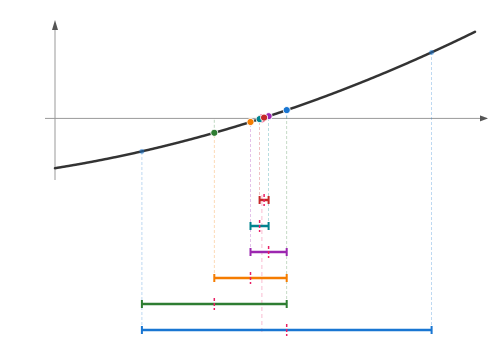
Find the root $x^* = \sqrt{2} \approx 1.4142$ of $f(x) = x^2 - 2$ on the interval $[1, 2]$. We have $f(1)=-1 < 0$ and $f(2)=2 > 0$.
| $n$ | $a_n$ | $b_n$ | $c_n$ | $f(c_n)$ | Selection |
|---|---|---|---|---|---|
| 0 | 1.0000 | 2.0000 | 1.5000 | $+0.2500$ | Left half |
| 1 | 1.0000 | 1.5000 | 1.2500 | $-0.4375$ | Right half |
| 2 | 1.2500 | 1.5000 | 1.3750 | $-0.1094$ | Right half |
| 3 | 1.3750 | 1.5000 | 1.4375 | $+0.0664$ | Left half |
| 4 | 1.3750 | 1.4375 | 1.4063 | $-0.0225$ | Right half |
| 5 | 1.4063 | 1.4375 | 1.4219 | $+0.0217$ | Left half |
The sign of $f(c_n)$ changes as $+, -, -, +, -, +$, while the interval width decreases as $1.0 \to 0.5 \to 0.25 \to \cdots$, halving at each step and converging to the root $x^* = \sqrt{2}$.
 $x$
$y$
$f(x) = x^2 - 2$
$x^* = \sqrt{2}$
$a_0$
$b_0$
$c_0$
$a_1$
$b_1$
$c_1$
$a_2$
$b_2$
$c_2$
$a_3$
$b_3$
$c_3$
$a_4$
$b_4$
$c_4$
$a_5$
$b_5$
↑ Converges to root
$x$
$y$
$f(x) = x^2 - 2$
$x^* = \sqrt{2}$
$a_0$
$b_0$
$c_0$
$a_1$
$b_1$
$c_1$
$a_2$
$b_2$
$c_2$
$a_3$
$b_3$
$c_3$
$a_4$
$b_4$
$c_4$
$a_5$
$b_5$
↑ Converges to root
7. Frequently Asked Questions
Q1. What is the bisection method?
Given a continuous function $f$ with $f(a)f(b)<0$, the bisection method repeatedly halves the interval and selects the subinterval containing the root. Convergence is guaranteed by the Intermediate Value Theorem.
Q2. What is the convergence rate of the bisection method?
It exhibits linear (first-order) convergence: each iteration halves the interval width. To obtain $k$ decimal digits of precision, approximately $3.32k$ iterations are required.
Q3. What are the disadvantages of the bisection method?
The main disadvantages are its slow convergence, the requirement that $f$ change sign over the initial interval, and the difficulty of extending it to multiple dimensions.
Q4. Can the bisection method be extended to multiple dimensions?
For a scalar-valued function $f: \mathbb{R}^n \to \mathbb{R}$, one can parameterize the segment between two points as $g(t) = f(\mathbf{a} + t(\mathbf{b} - \mathbf{a}))$ and apply the standard one-dimensional bisection method. For a vector-valued system $\mathbf{f}: \mathbb{R}^n \to \mathbb{R}^n$ a single sign cannot tell which side contains the root, so the method does not apply as is (generalizations based on the combination of componentwise signs or on the topological degree exist, but they are beyond the scope of this article).
8. References
- Wikipedia, "Bisection method" (English)
- R. L. Burden & J. D. Faires, Numerical Analysis, 10th ed., Cengage, 2016.
- W. H. Press et al., Numerical Recipes, 3rd ed., Cambridge, 2007.
Implementation in sangi
The algorithm in this article is available in sangi's bisection.